 Best Chainsaw
Petrol chainsaws
Best petrol chainsaws UK: from firewood to felling
A petrol chainsaw runs on a two-stroke engine, sized in cc (cubic centimetres), built for regular firewood processing, felling and storm-clearance work where mains power or a battery simply won't keep up all day. Something in the 35 to 45cc range with a 14 to 16in bar covers most UK firewood and garden use. Step up to 50cc and above only once you're regularly felling larger trees or clearing genuinely big timber.
Guide reviewed for accuracy: 10 July 2026
What cc chainsaw do you actually need?
Engine size is the single most useful spec on a petrol chainsaw box. It tells you roughly how much timber the saw can chew through and for how long before it's straining. A 50cc saw is heavier, thirstier and more tiring to run one-handed through an afternoon of fence-post-sized rounds than a 40cc saw built for exactly that job, so bigger isn't automatically better. Match the cc to what you're actually cutting most weeks, not the biggest tree you might theoretically fell once a year.
| Engine size | Bar length | Typical UK use | Example models |
|---|---|---|---|
| Up to ~32cc | 14in (35cm) | Occasional light pruning and small branches, tight budget or infrequent use | Stihl MS 170, Stihl MS 181 |
| 35 to 45cc | 14 to 16in (35 to 40cm) | Most UK firewood processing and general garden clearance, the sweet spot for homeowners | Stihl MS 212, Husqvarna 120 Mark II, Husqvarna 435 II |
| 50cc and up | 16 to 20in (40 to 50cm) | Felling larger trees, heavy storm-clearance, frequent or semi-professional use | Stihl MS 271, Husqvarna 555 |
Not sure which row you're in? Answer three quick questions in the Fit Check tool on the homepage and it'll point you at a power type, bar length and PPE tier based on your actual task, not the biggest saw in the shop.
Real UK prices for a petrol chainsaw
Expect to pay somewhere around £120 to £350 typically for a decent homeowner-grade petrol saw from Stihl or Husqvarna, with the smaller 30 to 32cc entry models nearer the bottom of that band and the 35 to 45cc firewood saws (like the MS 212 or 435 II) nearer the top. Step into the 50cc-plus, semi-professional class and prices climb well past £350, sometimes considerably, before you're anywhere near a proper felling saw. Cheap unbranded petrol saws exist well under £120. Parts, servicing and safety-critical components like the chain brake are usually the first things cut on those, so check them before you buy on price alone.
One buy-path note: Stihl and Husqvarna petrol saws are sold through approved dealers or the brands' own websites in the UK, not through Amazon, B&Q or Screwfix. That is normal for these two brands, but it does mean you can't price-compare them across shops the way you can with the more widely stocked mid-market brands below.
Three petrol chainsaws that suit most UK buyers
The Stihl MS 212, Husqvarna 120 Mark II and Husqvarna 435 II cover most of what UK buyers actually need, from a first, occasional-use saw up to a proper firewood workhorse. We picked them on published manufacturer specs, widespread UK dealer availability and consistent feedback from owner reviews and forums, not staged testing.
Stihl MS 212
Stihl
A 35.2cc all-rounder that sits right in the middle of the useful range: enough engine for a season of firewood and the odd small tree, without the weight and price of a felling saw.
Pros
- + 35.2cc engine comfortably handles a season's firewood
- + Up to 16in bar covers most rounds and the odd small tree
- + Parts and servicing widely available at UK Stihl dealers
Cons
- − Pull-start and fuel mixing add a bit of ritual over a battery saw
- − Heavier in the hand than an equivalent cordless model

Husqvarna 120 Mark II
Husqvarna
A genuine step up from the smallest 30cc saws while staying light and easy to start, the model that keeps turning up as a recommended first petrol saw in UK owner forums.
Pros
- + 38.2cc X-Torq engine is a genuine step up from entry 30cc saws
- + Lighter and more forgiving to start than bigger Husqvarna models
- + Widely stocked at UK garden machinery dealers
Cons
- − Air-injection filter still needs regular cleaning
- − Not built for repeated felling beyond small trees

Husqvarna 435 II
Husqvarna
More headroom than the MS 212 or 120 Mark II, worth the extra weight and price if your rounds run larger or you're cutting for longer stretches at a time.
Pros
- + 40cc X-Torq engine gives more headroom than the 120 Mark II
- + LowVib dampening noticeably reduces hand and arm fatigue over a session
- + Supports bar sizes up to 16 to 18in depending on the kit fitted
Cons
- − More saw than most people need for occasional pruning
- − Sits above the MS 212 and 120 Mark II on price
Stihl MS 212: the middle-ground firewood saw
The 35.2cc MS 212 sits right in the middle of the useful range for UK homeowners. It's a low-vibration, 2-MIX engine with a pre-separation air filter that extends the time between cleans, and it's rated by Stihl for cutting firewood and felling small trees rather than just light pruning. With a 16in bar it'll take on most rounds a UK garden or smallholding throws at it without the extra weight of a felling-class saw.
Husqvarna 120 Mark II: the budget-friendly first petrol saw
The 120 Mark II's 38.2cc X-Torq engine puts it a clear step above the smallest 30cc-class saws while staying light and easy enough to start for someone buying their first petrol chainsaw. It's consistently one of the more affordable Husqvarna petrol models stocked by UK garden machinery dealers, which is why it turns up so often as a recommended starter saw in owner forums and reviews.
Husqvarna 435 II: for bigger rounds and bigger gardens
At 40cc, the 435 II has more headroom than either the MS 212 or the 120 Mark II, useful if your firewood rounds run larger or your garden is big enough that you're cutting for longer stretches. Husqvarna's LowVib dampening is a genuine comfort feature over a long session, and the saw takes bar sizes up to 16 to 18in depending on the kit, though most UK owners run it at 16in for firewood work.
A petrol saw you can actually price-compare online
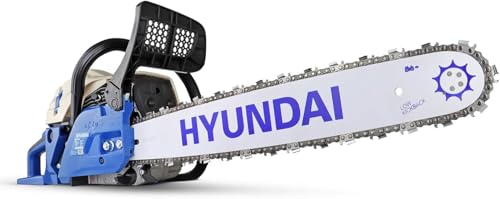
The Stihl and Husqvarna picks above are dealer-channel, bought through an approved dealer or the brand's own site rather than general retailers, so there is no honest multi-retailer price grid to show for them. Here instead is a petrol saw that genuinely is stocked online across multiple retailers, the Hyundai HYC6200X. Worth noting it's a larger 62cc saw, above the 35 to 45cc homeowner sweet spot covered earlier, simply because that's what happens to be well stocked online. The cc guidance above still stands when you're choosing by task.
| Retailer | Price | What you get | Buy link |
|---|---|---|---|
| Hyundai (direct) | £129.99 | 62cc, 20in/50cm bar, 3-year warranty | View product → |
| Amazon UK | Check price | Live price on Amazon | View on Amazon → |
Also listed at ManoMano, eBay and Robert Dyas; we link the brand-direct price we could verify and let Amazon show its live price.
Indicative prices from the dates shown, not a live feed. Stock and prices change often, so we deep-link each listing and let the retailer show the current price. As an Amazon Associate we earn from qualifying Amazon purchases.
Starting and maintenance: the trade-off for more power
A petrol saw needs more upkeep than an electric or cordless one: fuel mixing, filter cleaning, chain tensioning and a proper starting routine, not just pull the trigger. Go in knowing that before you buy, not the first time it won't start.
- Fuel mixing: petrol saws run on a 50:1 petrol to two-stroke oil mix (see the FAQ below), mixed fresh every few weeks rather than left to sit in the tank.
- Air filter: sawdust clogs the air filter faster than most owners expect. A dirty filter is one of the most common causes of hard starting and lost power.
- Chain tension: check and adjust before every session. A loose chain wears the bar and is a genuine safety issue, not just a performance one.
- Starting technique: choke, primer bulb and a firm pull are all part of the routine. Cold starts in particular take some getting used to compared with a trigger-start cordless saw.
- Noise and fumes: two-stroke engines are loud and produce exhaust fumes, both of which matter for how and where you can reasonably use one (see the FAQ on noise below).
The bar and chain themselves wear out on every power type, petrol included. If yours is cutting crooked, chewing through chains fast or the bar looks bent or grooved, our step-by-step guide to replacing a chainsaw bar covers picking the right replacement and swapping it safely.
Mix and store two-stroke fuel outdoors, away from any ignition source, and never smoke near it. Full EN381 PPE, chain brake, cut-resistant trousers, gloves, eye and ear protection, applies every time the engine is running.
How we choose
We do not run a test lab and we do not stage saws cutting logs for a camera. Best Chainsaw is research led: recommendations are built from published manufacturer specifications, verified owner and community reviews (Arbtalk, forums, Amazon UK and retailer reviews), UK retail pricing, and HSE/EN381 safety standards, cross-checked so the numbers on this page match the numbers on the box. Where a figure is the maker's claim rather than an independently measured result, we say so.
Rankings weigh bar length and power for the task, safety features, build and value at UK prices. We update picks when models are discontinued or superseded. We earn affiliate commission on some links, but it never decides the order of a list. More on our method.
Related guides
- Best chainsaw for processing firewood, the full power-type comparison for a typical log pile.
- Chainsaw safety: PPE, kickback and technique, EN381 PPE tiers and HSE guidance before you cut.
- How to replace a chainsaw bar, sizing and fitting a replacement bar safely.
- Fit Check tool, match your task to a power type, bar length and PPE tier in under a minute.